


KJV Holy Bible
Nicolas momo
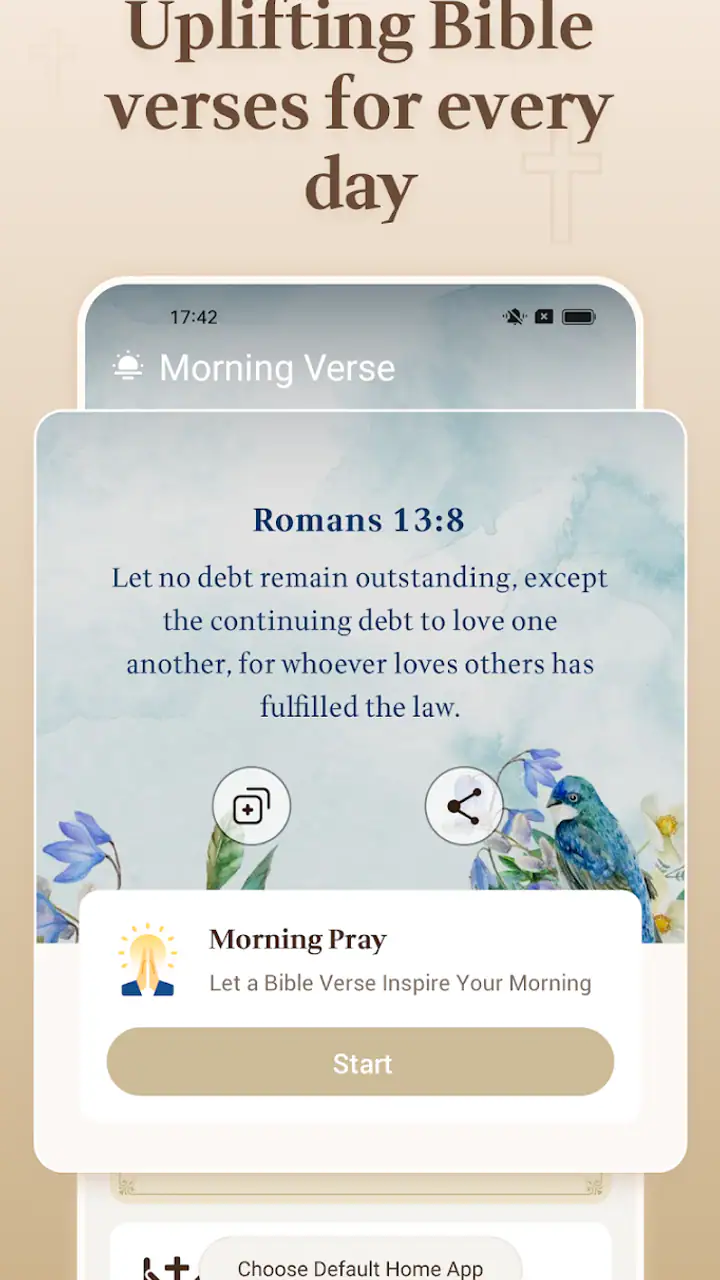
I found KJV Holy Bible most useful when I treated it as a quiet, dependable reading tool rather than as a feature-heavy study platform. It is a free Books & Reference app from Nicolas momo, centered on the King James Version, daily verses, devotions, trivia, and access from the launcher. The biggest practical advantage is that its core experience works offline, which makes it easy to keep available on a phone even when I am traveling, conserving data, or reading somewhere with poor reception.
That simple focus also makes it suitable for a household device. One person can open it for a morning reading, another can return later for a verse or trivia session, and nobody needs to manage a complicated setup before using the basic content. I would not describe it as a replacement for every Bible study app, but I can see why it has attracted over 100 thousand installs and a 5.0 average from around 1.6 thousand ratings. It feels designed for immediate access, not for making the reader learn a large system first.
How it works on a shared household phone
A practical way to share one device
Imagine a family tablet or an older phone kept in a kitchen, living room, or bedside area. In the morning, one person can read the daily verse, while someone else uses the same device later for a short devotional. Because the app does not depend on an internet connection for its main reading experience, the device can remain useful in places where Wi-Fi is unreliable. That is a meaningful benefit for a shared device that may not always have an active data connection.
I also like the distinction between quick access and longer reading. A daily verse is suited to a brief pause before work or school, while the Bible text gives the reader a reason to stay longer. Trivia adds a lighter way to revisit biblical knowledge, which may work well when several people are sitting together and want something more interactive than simply passing the phone around.
The launcher access is particularly relevant in a household setting. It can make the app feel closer at hand than a title buried in a crowded app drawer. I would use that shortcut for a regular reading habit, but I would avoid placing the device where accidental taps or casual browsing could interrupt someone else’s routine. The feature is convenient because it reduces steps; it also means the shared device benefits from a little thought about where it is kept.
Related News

Why WhatsApp Messenger Still Makes Everyday Communication Feel Easy

Jurassic World: The Game Is the Better Dino Tycoon for Strategic Players

Threads in Real Life: Who Should Join, Lurk, or Leave

How SHEIN Turned Shopping Into an Endless Content Feed

How to Make Fortnite Feel Smarter on Mobile

Should You Switch to Microsoft Outlook on Mobile?
What to decide before putting it on a common device
The app is free, which removes the most obvious barrier to trying it on a family phone. Still, free does not mean every household will use it in exactly the same way. Before making it the default reading app, I would decide whether the device is meant for personal reflection, group reading, or quick reference. Those are different habits, and the same interface may feel more or less comfortable depending on the purpose.
For personal use, I would keep the app on my own phone and use the daily material as a prompt. For group use, I would place the device somewhere everyone can reach and agree that the person holding it reads aloud or passes it on after a section. This is not a special collaboration mode; it is simply a practical routine that prevents the app from becoming one person’s private tool on a shared screen.
Another useful boundary is separating reading time from trivia time. Trivia can make the app more approachable for younger readers or for relatives who are less comfortable with long passages, but it can also change the mood of a quiet devotional moment. I would use the two parts intentionally instead of treating them as one continuous activity.
Gallery
Keeping expectations clear between users
One point worth understanding is that offline access helps with availability, not with household coordination. If several people use the same phone, the app does not automatically explain who read what, what another person intended to revisit, or whether a daily verse has already been discussed. I would handle that with a simple note, a shared conversation, or a regular time when the device is available.
This matters because users often expect shared apps to remember individual preferences. A personal Bible app can become part of someone’s private routine, while a shared installation needs a little more cooperation. If your household wants separate reading histories, individualized study plans, or clearly divided profiles, I would look at an account-based alternative instead. KJV Holy Bible is better suited to common access than to managing several distinct identities.
On the other hand, that lack of complexity can be a strength for some families. There is no need to teach every user a separate workflow just to open a verse. A grandparent, parent, or child can pick up the device and begin with the familiar reading material. For a household that values simplicity over detailed personalization, that trade-off feels reasonable.
Age, trust, and the meaning of an Everyone rating
The app carries an Everyone content rating, so it is naturally easier to consider for a broad household audience. I would still use normal judgment when handing any internet-connected device to a child, because the age label describes the app’s content context rather than replacing adult guidance about device use.
For younger readers, the trivia element may offer a gentle entry point, especially when a full reading session feels demanding. I would sit with a child at first and explain that the quiz is only one part of the app, not a substitute for understanding the passage. That small distinction helps keep the experience educational and respectful rather than turning the Bible into a score-driven activity.
For older children and teenagers, the offline design can be reassuring because the reading material remains available without needing constant connectivity. It also makes the app practical for travel or school-related downtime. I would not present it as a complete supervised reading environment, though. Families should still establish their own expectations about screen time, shared devices, and when a phone may be used.
Trust works differently for adults sharing a device. A partner or roommate may appreciate quick access to the KJV text but may not want another person changing the device arrangement. The simplest solution is to agree that the app is a common reference point and that personal notes, reminders, or broader study habits belong in each user’s own space. That keeps the app useful without pretending it offers separate household accounts.
Setup choices that make everyday use smoother
My first recommendation is to install the app on the device that will actually be available during the intended reading time. If the goal is a morning habit, a bedside phone may be better than a rarely used tablet. If the goal is family reading, a larger shared screen is more practical, even if it is less personal. The app’s offline behavior means the choice can be based more on comfort and access than on whether the room has a strong connection.
I would also open the app before the first shared session and make sure everyone knows where the daily verse, devotional material, Bible text, and trivia are located. This is a small step, but it avoids the awkward pause where one person is searching while everyone else waits. A short trial with each household member can reveal whether the text size, navigation, and reading pace feel comfortable on that particular device.
The launcher access deserves a deliberate decision. It is useful when the app is part of a daily routine, but not every shared phone needs a prominent Bible shortcut. On a personal phone I would welcome the faster entry point. On a family device, I would ask whether it helps the intended routine or merely adds another visible item that some users may not need.
Because the current version is 1.3.20 and the minimum operating system is Android 10, I would check the device before planning around it. A newer phone should be an easy candidate, while an older household handset may need attention before installation. This is especially important when the device is being prepared for a child, an older relative, or a community room where nobody wants to troubleshoot compatibility at the last minute.
A realistic daily workflow
Here is the routine I would suggest for a household. One person opens the daily verse during breakfast and reads it quietly or aloud. Later, another user returns to the devotional section for a few minutes. On a weekend, everyone can use the trivia feature together, then open the relevant Bible passage for a slower discussion. The same installation supports these different levels of attention without requiring each person to understand a complicated study system.
The key is not to force every user into the same pattern. Someone may only want a verse, while another person may prefer extended reading. The app works best when the household treats those as equally valid uses. I would avoid turning the daily material into a checklist that everyone must complete, because a shared device should make reading easier, not create another obligation.
Offline access changes the workflow in a useful way. A traveler can prepare before leaving home and continue reading on a train, in a waiting room, or during a break where mobile service is limited. A family can also keep a device ready for a quiet moment without depending on someone’s hotspot. This is one of the less obvious strengths of the app: its usefulness is not tied to the quality of the household connection.
Where this app is stronger than usual alternatives
Compared with a printed KJV Bible, the app is easier to carry and adds daily verses, devotions, trivia, and launcher access. A printed book still wins for people who want a screen-free experience, physical page marking, or a reading ritual that does not involve a phone. I would choose the app for portability and quick reference, but I would not tell a paper-book reader that digital access automatically feels better.
Compared with a general Bible app that supports many translations, KJV Holy Bible is more focused. That focus is helpful if the King James Version is the text you already prefer and you do not want to sort through translation menus. It is less suitable if you regularly compare wording between translations, need extensive cross-referencing, or want a broad academic study environment.
Compared with a devotional app built around personalized plans, this one feels more open-ended. I can use the daily material without committing to a long program, which is convenient for irregular readers. The trade-off is that people who want structured progress, detailed reminders, or a carefully sequenced course may find a dedicated study platform more effective.
Compared with a trivia-only religious app, the Bible text and devotional material give the questions more context. Trivia can be a doorway into reading rather than the entire experience. Still, anyone seeking a deep quiz system with extensive tracking may prefer a specialized alternative. The strength here is balance, not depth in one narrow area.
Limitations I noticed before recommending it
The offline design is valuable, but it can also encourage the assumption that the app is a complete replacement for every connected Bible resource. It is not the right choice if your routine depends on online commentary, live group tools, shared accounts, or continually updated study libraries. In those cases, a more connected platform will probably serve you better.
The KJV itself is another important consideration. Some readers appreciate its traditional language, while others find the wording slow or difficult, especially when reading aloud with children or people who are new to the text. The app’s convenience does not remove that language barrier. I would recommend it confidently to someone who specifically wants KJV reading, but I would suggest a different translation-based app to a reader who needs modern phrasing first.
Shared-device use also has natural limits. Without separate household identities, users need to coordinate informally. That is manageable for a couple or a small family, but less comfortable for a large group where everyone expects personal continuity. If your main requirement is individual progress tracking, personalized bookmarks, or a private study history for each person, this compact approach may feel too basic.
Finally, trivia can be either a welcome change of pace or a distraction. I enjoyed the idea of switching between reflection and recall, but I would not use the quiz as the measure of a meaningful reading session. The app is at its best when the lighter features support engagement without taking over the purpose of the reading.
Who should install it
I would recommend it to KJV readers who want a free, offline-friendly Bible app that combines direct access to scripture with small daily prompts. It is especially practical for someone who moves between home, work, travel, and places with inconsistent connectivity. The launcher access makes sense for a reader who wants the Bible close to the front of the phone rather than hidden among less-used apps.
It is also a sensible choice for a household that shares one device and values easy entry. Parents, grandparents, partners, and roommates can all use the same installation, provided they understand that cooperation replaces separate account spaces. The Everyone rating makes it easier to introduce across age groups, while the trivia feature can give a family a short activity to discuss together.
I would skip it if you need multiple translations, advanced scholarly tools, extensive personalization, or a fully separated experience for each family member. I would also skip it if you dislike reading on a screen or find the KJV’s traditional language frustrating. In those situations, a printed Bible or a broader study app would be a better match, even if it offers less of this app’s simplicity.
My household verdict
After using it as both a personal reference and a possible shared-device app, I see KJV Holy Bible as a focused tool with a clear audience. Nicolas momo has kept the experience approachable: the app is free, the central text is familiar to KJV readers, and offline access removes a common source of friction. Its daily verses, devotions, trivia, and launcher entry point give it more range than a basic digital book without making it feel overloaded.
The most important trade-off is personalization. I would gladly put it on my own phone or on a household tablet where people are comfortable sharing one reading space. I would be more cautious on a device used by several people who each expect private progress, separate preferences, or detailed coordination. The app does not need to become a family-management system to be useful, but the family does need to agree on how the shared device will be used.
Released on January 17, 2025, and available for Android users on version 10 or later, it is an easy recommendation for the right reader rather than a universal Bible solution. My final view is simple: choose it for convenient KJV access, offline reading, and flexible household use; choose another option when deep study tools or individual account boundaries matter more.
For a reader who wants a Bible close at hand without paying for access or depending on a connection, I think it earns a place on the phone. For a family, I would introduce it with a small agreement about shared use, then let each person decide whether the daily verse, devotional reading, or trivia fits their own rhythm. That combination of simple access and realistic expectations is where this app works best.
FAQs for KJV Holy Bible
What is the KJV Holy Bible app?
The KJV Holy Bible app is a mobile Bible reader centered on the King James Version, one of the most recognized English Bible translations. It typically lets users browse the Old and New Testaments, search for words or passages, and read Scripture on an Android or iOS device. Depending on the edition, it may also include bookmarks, notes, highlighting, daily verses, and reading plans.
Does the KJV Holy Bible app work without an internet connection?
In most cases, the main Bible text can be accessed offline after the application has been installed, which is useful when traveling or when mobile data is unavailable. However, features such as audio Bible playback, advertisements, synchronization, sharing services, or additional study resources may require an internet connection. Users should check the app’s description and download the desired content before going offline.
Is the KJV Holy Bible app free to download and use?
The KJV Holy Bible app is generally available as a free download, allowing users to read the King James Version without purchasing a physical Bible. Some editions may contain advertisements, optional donations, or premium features such as ad removal, audio narration, advanced study tools, or extra translations. Before installing, review the store listing and in-app purchase information to understand what is included at no cost.
What features are available for studying the Bible?
Besides basic reading, the app may provide useful study features such as keyword search, adjustable text size, night or dark mode, bookmarks, highlights, personal notes, and verse sharing. Some versions also offer reading plans, daily notifications, cross-references, or audio narration. Feature availability can differ between developers and platforms, so users should confirm the exact tools offered by the specific KJV Holy Bible app they intend to download.
Is the King James Version suitable for everyone?
The King James Version is valued for its traditional language, literary style, and long history of use, making it especially appealing to readers who prefer classic English Scripture. However, words and expressions such as “thee,” “thou,” and older grammatical forms may feel difficult for new readers. Those seeking simpler modern wording may want to compare the KJV with another translation while using this app for reference or traditional reading.
Pros
- Clear King James Version text with familiar traditional wording.
- Includes both Old and New Testaments in one app.
- Useful for personal study
- church reading
- and daily devotionals.
- Works well for readers who prefer a classic Bible translation.
- Usually offers quick access to individual books and chapters.
Cons
- Archaic language may be difficult for new or younger readers.
- Some editions may contain advertisements or optional paid features.
- Search tools and navigation can vary depending on the app version.
- Not ideal for users seeking modern translations or inclusive language.
- Audio
- notes
- and study resources may be limited compared with premium Bible apps.


